Showing posts sorted by relevance for query Portuguese. Sort by date Show all posts

Sunday, February 28, 2021

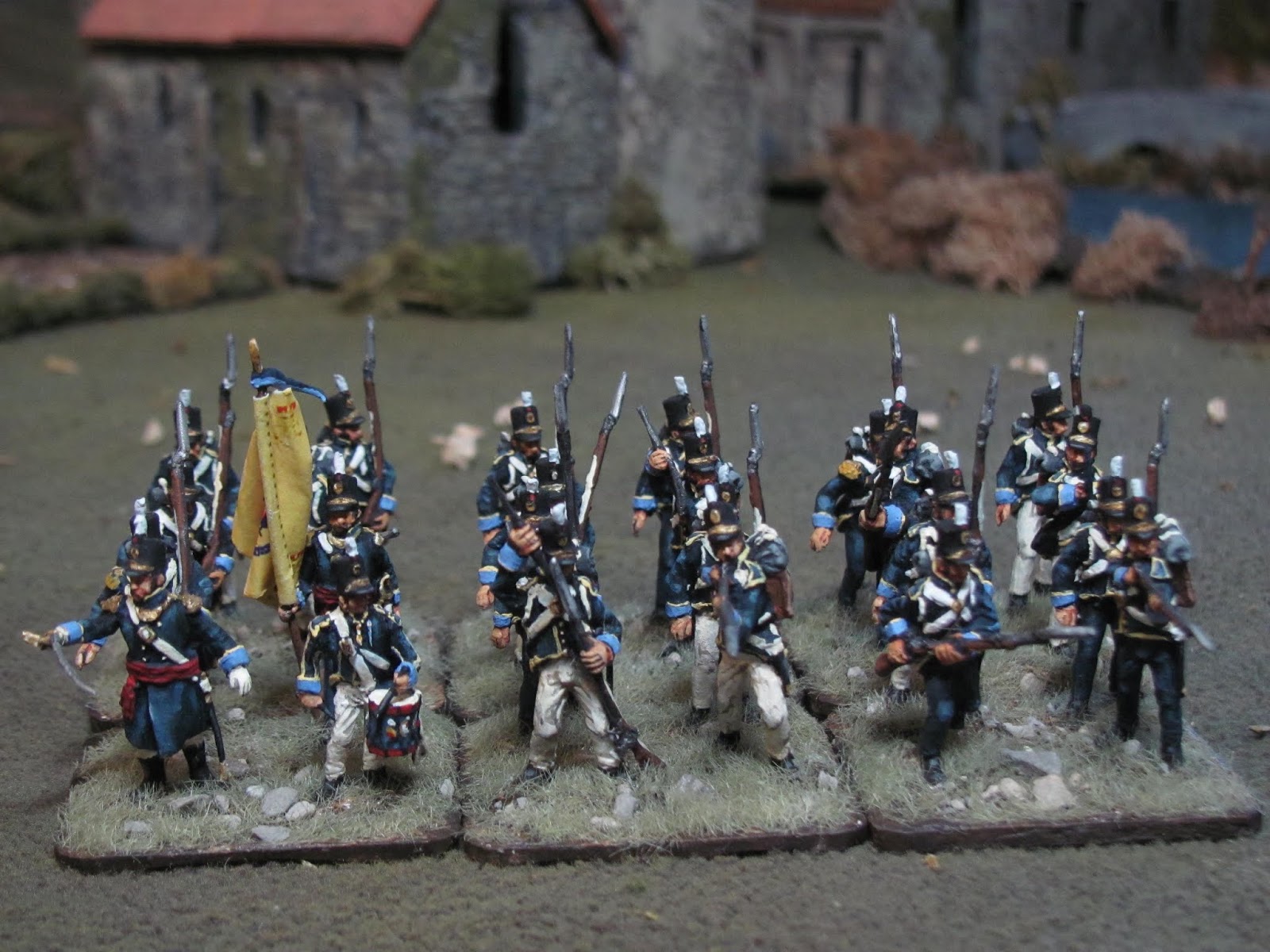
Portuguese 9th (Viana) and some grenadiers

My newest edition to the Portuguese army, the 9th (Viana). These figures are by Emhar.

I received a number of figures from a friend a few months ago, including the Emhar Peninsular War Portuguese set. This set is roughly split between Caçadores and grenadiers (identifiable by their shoulder wings and sword), and all wear the old barretina shako, dating them as probably earlier than 1809 before the British stovepipe shako and British supplied uniforms and equipment had started to become the norm.
Portuguese in the 1806 uniform, an illustration by Michael Roffe from the Osprey book The Portuguese Army of the Napoleonic Wars. Note the shoulder wings and sword that denote the figure on the lower right as a grenadier.


Six new stands of grenadiers to round out my Hagen fusiliers.


I hadn’t purchased these figures earlier myself as they always seemed a bit stiff and parade ground-like to me, but now that I had them in my possession, on closer inspection I discovered that despite this the sculpting on them was very good and well-defined. A few years ago I had purchased enough Hagen metal figures to create about three and a half battalions of Portuguese line infantry (which can be viewed here) but all of these fine figures were fusiliers, dressed with trousers and wearing the stovepipe shako. The Hagen uniform better conforms to the Portuguese post-1809, as supply issues and British support gradually had the official 1806 uniform migrate towards something more closely approximating that which their British counterparts wore.
The Emhar figures gave me enough to create a new battalion (9th, Viana) and increase the size of the others so that I would have five plus battalions. I could also now give each battalion its requisite stand of grenadiers. I decided that the Caçadore figures (with their swords and shoulder fringes carved away) could serve nicely as fusiliers, but what to do with those barretina shakos and half gaiters? 

Emhar figures with head swaps and sculpted trousers.


To integrate the Emhar figures with my Hagens I opted to replace half the Emhar heads with the stovepipe shakos and sculpt trousers on the same number. In this way I hoped I would end up with a mixed look that would represent the gradual transformation over to the British style uniform in the post 1809 period of the Peninsular War. With the conversion of a few left over Hagen figures and Italeri British drummers I was also able to create two new command stands. As always with my Portuguese, some even got moustaches!

Hagen figure converted into ensign, back and front. I gave him a gorget, left shoulder epaulettes, a sash and a sword with cross belt.


The result gave me now five battalions of Portuguese line in a transitional uniform dating from 1809-10. These are the 2nd (Lagos), 4th (Freire), 8th (Castel de Vide), 9th (Viana) and 12th (Chaves) as well as part of the 10th (Lisboa).

All five Portuguses battlaions (plus the beginning of a sixth, the 10th Regiment (Lisboa)


Emhar grenadiers. I did a few head swaps to give some stovepipe shakos and sculpted trousers on others in an attempt to have them integrate better visually with my Hagen Portuguese.

Rear view of same. Interestingly, where the Emhar figures, even though they wear a uniform dating earlier, have the Trotter backpack while the Hagen figures have a more shapeless pack similar to that of the French.

Emhar Caccadores covnerted to fusiliers, by simply carving off the sword and shoulder fringes. Again, I made some head swaps and sculpted trousers on a few of the figures. The braiding on the front of the jacket is only slightly raised and easily painted over.

On all of the Emhar barretina shakos I opted not to paint the cord as I thought it would make them too showy and less integrated with the Hagen figures.


The  9th command stand with the converted Hagen figure as ensign.


A command stand for the still understrength 10th (Lisboa). The mounted offficer is Hagen, the drummer boy a converted Itlaeri British (the inverted drum gives himaway!) and the standard bearer another Hagen figure, a converted sergeant. The white banner and turn backs indicate that this regiment was recruited from the Portuguese Central Division.


A bit of History

In response to the Portuguese government’s request for help, on March 7, 1809, by decree, Major-General William Carr Beresford was appointed Commander-in-Chief of the Portuguese army. Under Beresford’s reorganization the army was rebuilt, virtually starting from nothing. The French, under Junot, had dismantled the three levels of Portuguese national defence, disarming and disbanding the militias and ordenanças and sending the line infantry off to France to fight in Napoleon’s far flung wars. It was the troops of the disbanded militias that eventually became the first rate line battalions that fought side by side with the British throughout the Peninsular War.

Although the Portuguese battalions were eventually fully integrated at divisional level into Wellington’s army (accounting for up to a third of his total force by 1810) at brigade level and below the Portuguese maintained their own internal structure. Each regiment was composed of two battalions, with each battalion nominally having seven companies, one of these companies being grenadiers. The Portuguese line battalions had no light infantry companies, with their light infantry instead coming from their battalions of brown-uniformed Caçadores.

During the Douro campaign (Second Invasion) Portuguese battalions were found in mixed brigades with the British. However, this was the only campaign where that was the norm. On February 22, 1810, Wellington ordered each Division to include a Portuguese brigade composed of two infantry regiments of two battalions each and a battalion of Caçadores numbering 2000-2500 men (as opposed to the British numbers of two to three battalions numbering 1500-2000 men). There were three exceptions to this; the 1st Division had no Portuguese brigade, the Portuguese Division was composed entirely of Portuguese brigades and the Light Division had British light battalions and Portuguese Caçadore battalions brigaded together.

For further reading:
O Combatente Portugês da Guerra Peninsular (1807-1814) by Nuno Lemos Pires
The Portuguese Army of the Napoleonic Wars by Otto von Pivka, illustrated by Michael Roffe

Monday, June 18, 2018

Napoleonic Portuguese

Last February, for my birthday I treated myself to a big order of 1/72 Portuguese Napoleonics from Hagen Miniatures. At some point I realized that if I was going to fight my way through the Peninsular battles I would need more than just the French and Spanish armies that I had laboriously built up over the past few years.
I had already embarked upon a fledgling British army, but as any student of the  Peninsular Wars knows, a full third of Wellington's army were Portuguese regiments. By all accounts the Portuguese army was in a pretty sorry state by the time the first British troops arrived in Portugal as years of inactivity and nepotism had left them ill- equipped to challenge the invasion of their country by Napoleon's forces.
But soon after their arrival the British, with some understandable resistance by their Portuguese hosts, began to reorganize their army along the British model. This task was allocated to Beresford, a mediocre British fighting general who proved himself remarkably up to the task. Early on much of the Portuguese officer class dead wood was stripped away, elderly and ineffective generals pensioned off and younger more competent officers promoted. But more significantly, a large number of British officers were drafted into the Portuguese army, with the offer of a one level rank increase for their services. A system was set up for the higher ranks built on the principal that if a Portuguese officer was in a position of command the officers immediately above and below them were English and vice versa.
Under this reorganization the Portuguese forces were rapidly brought up to a high level of competency and deported themselves with honour and pride throughout the remainder of the war, with the possible exception of the cavalry who always performed with mixed effectiveness and were never integrated into the British army to the same degree. However the infantry and artillery regiments  were thoroughly integrated into Wellington's army, typically one Portuguese brigade paired with two British in each division, with the divisions always under command of an English general.

Anyone who has looked for 1/72 Portuguese Napoleonic miniatures knows that options are limited, the only figures available in plastic that I'm aware of being a set of mixed cazadores and infantry by Emhar. The figures are well enough done, but I find the Emhar detailing too lightly defined and the poses too wooden to be that appealing. I had already seen some beautifully sculpted  Spanish cavalry in metal on the Hagen site which I had been coveting and had discovered a really nice range of Portuguese figures  http://www.hagen-miniatures.de/index.php/en/component/jshopping/category/view/322 so I put in an order for a modest-sized force, enough for three or four brigades of infantry, a brigade of cavalry and three batteries of artillery for the AoEII ruleset we use in our group - about 130 or 140 figures in total.
For the infantry I decided to paint them up with regiments representing each of the three traditional Portuguese divisions, with each division having its own colour carried on the turnbacks (yellow for the north, white for central and red for the south based on the recruiting areas for each regiment). A full chart for the Portuguese infantry uniform colours can be found here  http://blundersonthedanube.blogspot.com/2014/02/portuguese-napoleonic-line-infantry.html
The Hagen figures are modeled with the stovepipe style 1810 shako, and I elected to paint them with a mixture of the winter and summer dress, which translates simply to either blue or white trousers.  Some of the figures were modelled as NCO's, which the Osprey books indicate would have yellow braid epaulettes as were their sword sashes. Officers wore gold epaulettes and red waist sashes, the  sashes often with silver tassels. Cavalry and artillery also wore the same regional divisional colours on turnbacks with regimental colours on piping and cuffs.
All the flags came from Warflags and there is good flag information on that site.

Further reading on the Napoleonic Portuguese army:
Nafziger's Armies of Spain and Portugal 1808-1814 http://www.reenactor.ru/ARH/PDF/Nafziger.pdf
Oman's Wellington's Army 1809-1814 http://www.gutenberg.org/ebooks/56318
My modest Portuguese army, four brigades of infantry, one of cavalry and three batteries of artillery.

5th Cavalry Regiment (Evora) I added a flag-bearing arm on the standard bearer and some epaulettes and sash on the commander. The horses in this set were full of life but a bit large, requiring a bigger base than normal to accommodate. The figures came with alternate heads wearing shakos, perhaps more appropriate for the later years when the British were there but I liked the leather helmets so stayed with those.

8th Regiment (Castelo de Vide). I opted for the King's colours on some (such as this regiment) and the regimental colours for others. I believe every regiment would traditionally have carried both, the first carrying King's colours and the second battalion regimental colours.

12th Regiment (Chaves) with regimental colours (the colour corresponded with the regional division colour).

2nd Regiment (Lagos) with regimental colours.

4th Regiment (Freire) with King's colours.

Command stand and casualty. I had ordered the Hagen command set but in the end only used these two figures, converting the other two to British officers (see previous post). In the AoEII level of game I only need divisional commanders who were almost exclusively British in Wellington's army.

Artillery with the south divisional colours. Each cannon came with six figures so I ended up with a lot of extra artillery figures which I am converting to British!

Sunday, May 27, 2018

Wellington and generic Peninsular generals, British and Portuguese


Anyone who collects 1/72 Napoleonic miniatures knows that British and Portuguese staff figures are hard to come by.
Eager to try my hand at creating a figure for Wellington, I committed the greatest heresy possible and decided to use a mounted Napoleon figure from the Italeri French command set as my starting point!
Napoleon, soon to be Wellington (Italeri) with a Portuguese captain from Hagen on the block to be made into a British aid.
The horse stayed mostly the same, with a bit of work on the pistol covers on the bow of the saddle. Mostly the conversion consisted of a bicorne swap, a nose and sideburns job and sculpting a great coat and sash.
Front view.
And here he is as Wellington painted up. I sculpted a shoulder cape to the great coat of the aid, pointed the finger of his sword hand and placed a map in the other hand.

Another view. I had the Wellington figure all done and then my partner helpfully commented on the fact that he looked a bit squat - no doubt as a result of my using Napoleon to begin with! So off with the head and I added a bit of neck to make him a smidge taller, although he's still probably diminutive for a Wellington figure. Ah well, he'll do.

Now on a roll, I turned my eye to some Portuguese commanders I had. In my order of a Portuguese army with Hagen Miniatures back in February I included the staff command set, and then afterwards had to ask myself, "Why?!" I mean, it's a nice-looking set but as I well knew, the Portuguese fighting in Wellington's army (where these were destined) fought under English divisional generals almost exclusively. The only exception was the Portuguese general Lecor who served as acting commander of the 7th Division at the battle of Nivelle, going on to command the Portuguese Division to the end of the war.

The original Hagen figures (picture from their web site), two of which are on their way to becoming British and no doubt inspired by the image below (whose providence I'm unsure of)!

To that end I went to work on two of the figures in that set to see if they would convert to British. The results can be seen below and you can judge for yourself, but at least my Anglo-Portuguese brigades will now have some divisional commanders.

For this figure I gave it a head swap (Valiant head), a new bicorne placed front to back, added braid and a second set of buttons, a different collar to the coat and again reworked the pistol covers and added a tapered saddle cloth.

Another view.

And the final, with the over-sized Viceroy head popped off at the end and replaced with something smaller. It's amazing how much a head scales a figure!! This Hagen figure was on the large size to begin with and the Viceroy head made him look like a giant.

Another view.

The second figure got much the same treatment minus the braid, as did the horse, which I borrowed from my Italeri French command set.

The finished figure. Again, I popped off the Valiant head and replaced it with this one at the very end, after painting! I'm fairly certain the horse is helping decipher the map...

Another view.

Which left me with these two pompous-looking fellows, who I painted up as the Portuguese officers they were meant to be!
SaveSave

Wednesday, February 6, 2019

Portuguese Caçadores

I decided recently to add a battalion of Portuguese Caçadores to my Portuguese contingent of Wellington's army, light troops that fought with distinction alongside the British throughout the Peninsular campaign.
There are not many good sets of these available in 1/72. Emhar makes a set of Caçadores and infantry mixed, but I find the poses a bit stiff, the detail too lightly defined and the Caçadores in this set wear the earlier shako, similar to the British Belgic shako, which was quickly replaced with the stovepipe. There are some very fine Caçadore metal figures available through Hagen (from whom I purchased my Portuguese line infantry) but I needed them sooner than a trans-Atlantic order would take.
So I took a hard look at my HaT Peninsular British and decided they they would not be a difficult conversion. The biggest issue was the backpack and canteen - I could find no good reference for the packs and kit these troops used, and the Osprey images, as so often is the case, stubbornly show only the front of the figure. Then I had a "Eureka" moment, finding elsewhere in the Osprey book the image below, a period illustration showing Caçadores (Voluntarios Reales do Principe, formed in 1815) as they appeared in Brazil in 1815-16. Clearly shown is the British style backpack and canteen and notes indicated that the canteen was green. Whether this was the case with the earlier Caçadores, I don't know, but I elected to move ahead basing them on this information.

Caçadores in Brazil 1815-16 with British-style equipment.

The only conversions were to carve the lace off the cuff, give the cuff a point, alter the shoulder tufts into wings and, as a conceit, give them all moustaches.
 I was happy with the results but you can judge for yourself.

A bit of history...


6th Caçadores, 1811. Although this image shows the soldier with an ammunition pouch at the belt, the illustration of Caçadores above show them with strapped ammunition pouches worn British style.
The Caçadores (Portuguese for "hunters") were established in 1808 in order to give the Portuguese army, in the process of being reorganized, a light infantry contingent. The previous light troops, The Legion of Light Troops had been disbanded in 1807 and most of the men drafted into the French Portuguese Legion.
The first six battalions were authorized on October 14, 1808, with each battalion attached to a Portuguese city, as was the case with Portuguese line infantry. On 20 April, 1811 six more battalions were added to the Caçadores.
The Caçadores were trained in British light infantry tactics and over time gained a reputation as daring elite troops, fighting with distinction in Wellington's army throughout the Peninsular War.
The 6th Battalion, which these figures are based on, was located at Vila Real, fought at Busaco in 1810, Fuentes d'Orno and Arroyo dos Molinos in 1811, Alamaraz and Vitoria in 1812 and Nivelle in 1813.
6th Caçadores

6th Caçadores in skirmish formation. I based these on magnetic bases so they could do double duty is stands four up and skirmishers two up.

Command stand. The officer is an altered Hagen Line Infantry figure, based on the officer in the Osprey book.

Command stand

Caçadore stand.Conversions were adding a pointed cuff and changing shoulder tufts to wings.

Rear view.


Tuesday, August 17, 2021

1/52nd (Oxfordshire) Regiment of Light Infantry

In finishing painting the 52nd Light Infantry I have finally completed my goal set over a year ago to put together Crauford’s Light Division. My build of the 1/52nd was based on the Italeri figures I have used elsewhere in my British army. Although actually designed as a Waterloo era set, half the figures, representing the 29th, wear stovepipe shakos. The other half, 1st Guards, required some work on the Belgic shakos to give them the proper shape. Only a few of the figures have wings, so I experimented with sculpting wings on those missing them and was quite happy with the result! 

My 1/52nd in skirmish formation.

Because the light infantry officers traditionally wore shakos even at this point in the war, I decided to alter the shape of the Italeri Belgic shakos rather than do a head swap. I also added wings to the shoulders of these and many of the figures, which turned out easier to do than I had expected! The sergeant figure in this set, only armed with a stick, is useful for conversions. In the first figure I gave him a rifle and the third a homemade flagstaff. The centre figure was the commander figure, demoted to lieutenant and also given a flagstaff with an alteration on the right arm to hold it.

These figures were also fitted out with homemade wings and altered shakos.

Command stand.
A better view showing the altered flag bearers.

Fusilier stand with altered sergeant with rifle.

A Bit of History

My finished Light Division on the field.


The 52nd was originally raised as a line regiment in 1755, seeing action in the American War of Independence and the Anglo-Mysore Wars before their engagement in the Peninsular Wars. They were converted to light infantry in 1803 when the 1st Corps of Light Infantry was formed.


What was to become the Light Division went through various incarnations and arrangements, but at its heart were the 1/95th and 3/95th Rifles, the 1/43rd (Monmouthshire) and 1/52nd (Oxfordshire). Also part of the division at various times were Ross’s and Chestnut’s Horse Artillery troops, the 1st KGL Hussars, parts of the 14th and 16th Light Dragoons, 1st and 3rd Caçadores battalions and 1/17th and 2/17th Portuguese Line.

My version is the Division as it appeared in 1810 at the time of the Combat of the Côa on the Portuguese frontier when the 1st and 3rd Portuguese Caçadores had also joined the ranks. 


1/43rd and 3rd Portuguese Caçadores on left, 1/52nd and 1st Portuguese Caçadores on right, with 95th skirmishing out front. I really need more Rifles but at the moment can't lay my hands on the Italeri kit I have used to date. Thinking about buying some of those yummy Hagen Rifles!


The British regiments of the division were first brigaded in 1803 as the 1st Corps of Light Infantry, not being designated as the Light Division until several years later. They served Moore with distinction in Spain, notably keeping their discipline intact, fighting a series of rearguard actions during the exhausting and horrific British retreat back to Corunna.


Crauford’s brigade returned to Portugal, landing in Lisbon July 2, 1809 and after a gruelling march joining Wellesley just as the battle of Talavera was concluded. The Light Division went on to serve with distinction throughout the entire Peninsular War. Crauford himself, after a sojourn in England as a result of illness, returned to take command of the Division only to perish at the walls of Ciudad Rodrigo during the British siege of that city.