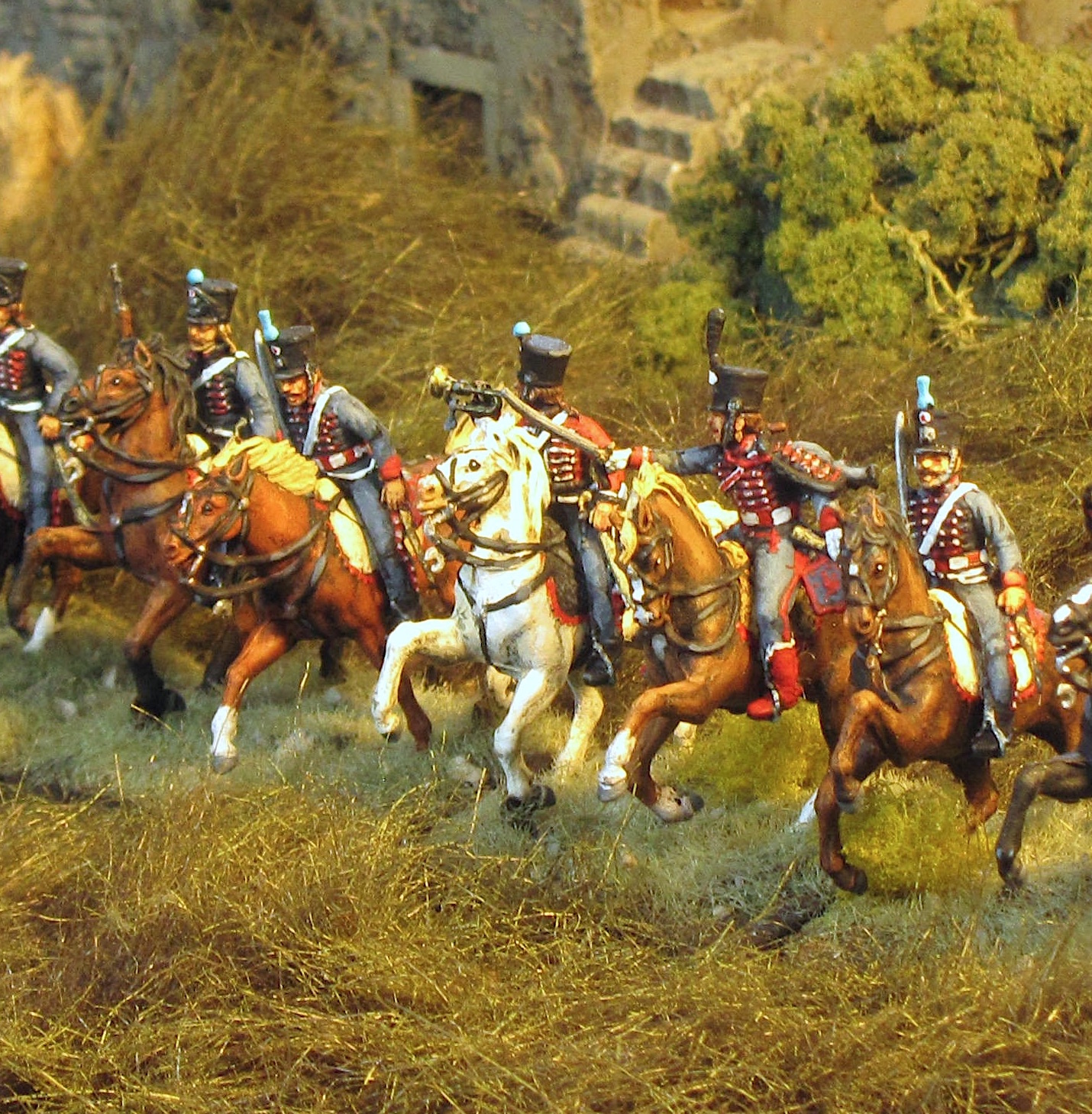
Inspired by the anniversary of the historic events that transpired in Normandy 75 years ago, I decided to dust off my WWII toys and play through some of the battles from the Blood and Honour series created by Paddy Green and Richard de Ferrars for the Battlefront WWII rules. This has always been my favourite WWII ruleset, but it can be a bit fiddly so I wanted to also test out a simplified version that I had developed to see if it still preserved the overall feel of the game.
I had not played the Damblainville scenario, so I tackled that solo, playing the smaller vignette option, which still put a pile of Canadian armour on the board! The game's background is set during the August 1944 attempt to close the Falaise pocket. With Falaise still stubbornly held by the enemy energies had become focussed on clearing an alternate way to Trun. To this end Lt General Simmonds ordered the 4th Canadian Armoured Division to advance on Trun by the most direct route possible. This passed through the village of Damblainville via its bridges that span the River Ante.
The objective for the Canadians is the seizing of the bridges over the Ante and clearing the way for vehicles to cross and exit the board.
The game was played on a 6' X 4' table with 20mm figures, using the Battlefront WWII rules with some home grown tweaking.

Final butcher bill puts the Canadians at about 25 infantry stands, two 6 pdrs. and 12 tanks lost to the German’s 12 infantry stands, one 75mm infantry gun and three Jagdpanzers, and with the south bank entirely in German hands this one definitely goes to the Germans.
I had not played the Damblainville scenario, so I tackled that solo, playing the smaller vignette option, which still put a pile of Canadian armour on the board! The game's background is set during the August 1944 attempt to close the Falaise pocket. With Falaise still stubbornly held by the enemy energies had become focussed on clearing an alternate way to Trun. To this end Lt General Simmonds ordered the 4th Canadian Armoured Division to advance on Trun by the most direct route possible. This passed through the village of Damblainville via its bridges that span the River Ante.
The objective for the Canadians is the seizing of the bridges over the Ante and clearing the way for vehicles to cross and exit the board.
The game was played on a 6' X 4' table with 20mm figures, using the Battlefront WWII rules with some home grown tweaking.
 The Battlefield

Damblainville as seen from the high ground (bottom) where the Canadians enter. Hedgerow-lined roads and fields made the initial advance difficult, especially under the watchful eyes of German artillery FO’s and armour.

The Objective
The objective for the Canadians is to seize a crossing at Damblainville. The Ante River is spanned by three bridges of indeterminate quality, a railway bridge to the west and two older stone bridges in the town itself.
Lurking in the woods bordering the Ante are German armour and dug in infantry of Kampfgruppe Olboeter, including a Tiger platoon (bottom) with a full view of the hills to the north and the 1st Panzerjager Kp. . A second German SS infantry company holds the town on the north side of the river with orders to fall back if things get too hot. A third ad hoc company of German engineers, supply and administration are held in reserve further back by the railbed (off picture to left).
 The German left

On the west side of the town a reduced Panzer IV company (IL/SS Panzer Regt. 12 “Hitlerjugend”) and German AT guns guard this bridge, with good lines of fire up to the heights beyond.
 1. The Canadians advance

The Canadians lead with their armour, throwing A and B Companies of the South Alberta Regiment forward, along with its recce Stuarts. Some tanks advance along the west road, but the lead tank is KO’d 9top right) by a hidden German Pak at the west end of Damblainville and erupts in flames, impeding the advance of the following tanks. A Firefly of A Squadron is also knocked out by a long shot from the German Tiger lurking in the woods east of the town by the railway bridge.
 2. Carrier platoon on right

On the right flank the Argyll and Sutherland’s carrier platoon quickly advances, with troops dismounting to seize the unoccupied buildings at the blocked crossroads.

3. Nebelwerfers!
As the first wave of armour rolls in the Canadian commander begins to feed A Company cautiously in along the hedgerows bordering the west road. Regardless they are spotted by the German FO, dug in on the bank of the railway bridge, and a nebelwerfer concentration draws first infantry casualties.

4. 6 pdrs. brought forward
Movement is spotted by the Germans along the eastern flank of the Canadian advance as the Highlanders try to move their guns forward to engage the German Tiger. They are slammed by artillery, causing the Highlanders’ anti tank platoon to loose a gun section. Leaving transport behind the remaining guns are cautiously manhandled forward to their positions.

5. Tough going
It’s out of the frying pan into the fire as the tanks and carrier platoon move out of sight of the Tiger only to come under intensive fire from the German positions west of the town. Another tank and a Bren carrier are brewed up as some of the carrier platoon infantry try and fail to fight their way into the houses on the outskirts of Damblainville under cover of smoke.

6. Germans hold tight
German Panzer IV’s and antitank guns on the south side of the river.

7. Centre bridge comes under attack
One of the South Alberta’s Stuarts is first to arrive at the town entrance opposite the centre bridge, only to be brewed up at short range by a hidden German infantry gun. A second is KO’d by the Tiger (lower left) reducing the recce squadron to half strength in a matter of minutes.
 8. Lurking Tiger

The deadly Tiger on the east flank with a clear view up the valley.
 9. 9 Kp. re-enters Damblainville

9 Kp., which had begun the fight on the north bank of the river, had withdrawn across the Ante when enemy armour began swirling around the town, leaving a small rearguard of panzerfaust and panzershrek-armed infantry along with an attached infantry gun to hold up the advance.
However, with enemy infantry approaching and the north bank still standing firm (despite the loss of the infantry gun) 9 Kp. re-enters the north bank, supported by a Jagdpanzer which takes up position at the east entrance to the town.
The hope is to hold of the enemy long enough to allow the engineers, newly arrived, to prepare the bridge for demolition.
The hope is to hold of the enemy long enough to allow the engineers, newly arrived, to prepare the bridge for demolition.

10. More casualties
Meanwhile at the west end of the town Highlanders’ A Platoon supported by B begin to fight their way into the outer edge of the town. C Company was also fed in on this flank but was pasted by a devastating artillery concentration before they made any headway, with three quarters of the company dead and wounded and the remainder falling back to the woods. Fireflies are brought in to try to bring some big guns to bare at close range but one is quickly knocked out before it can fire a shot.
 11. Engineers arrive

Back at the centre bridge, as 9 Kp. moves back across to try to hold the enemy at bay, German engineers arrive with explosives to begin wiring the bridge for demolition.
 12. South Alberta C Company enters the fray

The Canadian FOO’s, mostly out of action so far as the bad radio reception in the steep Ante valley compromises their ability to make contact with their artillery, finally connect and lay down a big smoke screen on the left flank. Under cover of this the third company of the South Albertans is sent in to try and reinvigorate the stalled attack.
 13. D Company is sent in

The Highlanders’ D Company is pushed up the left flank at the same time.
 14. Under cover of smoke…

Under cover of smoke some of the tanks rapidly make it down the road and into close range of the Jagdpanzer IV now sitting on the railway bridge.
 15. House to house fighting

Vicious and costly house to house fighting erupts in Damblainville as the Canadian infantry attempt to drive the SS out of the town. Casualties mount on both sides in the slog.
 16. Railway bridge shelled

A Mike target is called on the railway bridge, bringing the weight of the entire field regiment down. One of the engineer sections attempting to mine this bridge is knocked out.
 17. Another Firefly goes up in flames

The Jagdpanzer at the entrance to the town is KO’d, allowing Shermans to cautiously edge into town in support of their beleaguered infantry. Yet another Sherman is KO’d by one of the two Jagdpanzers still on this flank.

18. Stymied!
A traffic jam develops on the north side of Damblainville as the South Albertans try to sort themselves out. 6 pdrs, are moved up and infiltrated into some of the buildings to try and bring their support to bare.
 19. Another Jagdpanzer KO’d

As South Albertan C Company pours in on the Canadian left the preponderance of guns at close range begin to find their mark and the Jagdpanzer on the bridge is knocked out.
20. Saved by the panzerfaust!
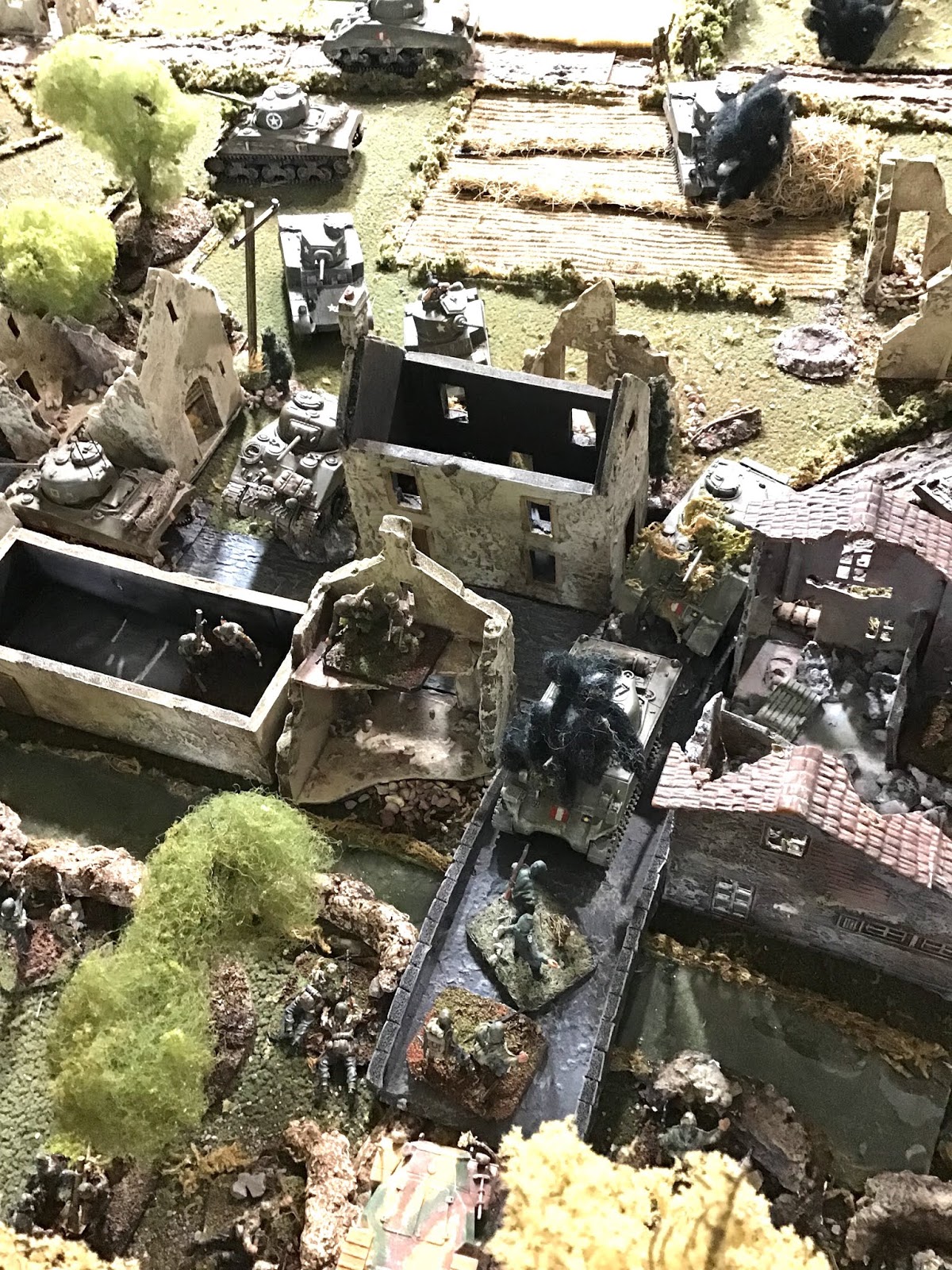
Most of the north bank houses are cleared of Germans and Canadian infantry and tanks begin pouring into the town. In an attempt to force the bridge the lead Sherman moves in to close assault the German engineers but is disabled by a lurking panzerfaust as the tank emerges from the south edge of the town.
 21. Canadian right

With the north bank secured, here too the South Albertans try to overwhelm the enemy defence by sheer number of guns but as quickly as one tank takes up position it is knocked out.
 22. Panzershrek!

On the western bridge the lead Sherman barrels across to engage the Panzer IV’s at close range, but is KO’d by a panzershrek. The tank catches fire and the erupting flames obscure the area in smoke, making it difficult for both sides to find their mark.

23. Third Jagdpanzer toasted
The Canadians succeed in taking out the third Jagdpanzer but the Tiger (top left), with no more targets available from its original position, lumbers over to help hold back the attackers.
 24. Still stuck on the wrong side of the river

On the Canadian right and badly mauled, the remaining Highlanders hunker down waiting for the armour to clear the way. But things have reached an impasse with no way to force the Germans on the south bank out of their positions.
 25. Tiger on the move

Not yet spotted, the German Tiger eases its way up to the railway embankment.
 26. Bridge mined

Explosives are placed on the centre bridge as the engineers prepare to remove themselves in order to detonate.
 27. What the hell is going on here??!!

At this moment Lieutenant Colonel Mitchell of the Highlanders weaves his way down through the carnage to the north side of Damblainville to see first hand what is holding up the attack. As panicked reports come in he finds that half his regiment has been lost in the fighting so far and that A, B and C companies are no longer capable of any sustained action, with only D Company left to clear out the SS who are still in control and dug in on the south bank. With almost half the South Albertans disabled and burning in and around Damblainville he sends message back to brigade HQ recommending calling off the attack. As it turns out bridges further north had been seized the night before without a fight regardless and the entire division has already been ordered to side step Damblainville and utilize this approach.
C’est le guerre.

Final Overview
Top bridge: One of the South Albertan Fireflies edges up onto the railway bed to explore this way forward, but the Tiger on the far side will control that access once the Sherman becomes visible on the bridge.
Centre bridge: A second Sherman has been KO’d in an attempt to force this crossing, and with the bridge now wired for demolition this approach will likely be denied. Regardless the panzerfaust responsible for two kills is still in place with a second in the wings.
Bottom bridge: The burning Sherman on the bridge has largely obscured the hull down Panzer IV’s beyond from effective fire, unless the range is closed dramatically. But with a third Panzer IV, 75mm AT gun, 75 mm infantry gun and panzershrek all within range of the bridge, this will be an almost impossible nut to crack.
The only real way forward would be to get some infantry across the river to shake things up in conjunction with a renewed attack by the armour but the Highlander casualties (50% of the regiment) leaves the remainder too casualty shy and without the numbers to take on the two intact German infantry companies dug in on the south side of the river.
Plagued by failed calls for fire and terrible dice, a very difficult scenario for the Canadians was made impossible! Thanks to Paddy and Richard for all their hard work in bringing this scenario together.
Plagued by failed calls for fire and terrible dice, a very difficult scenario for the Canadians was made impossible! Thanks to Paddy and Richard for all their hard work in bringing this scenario together.